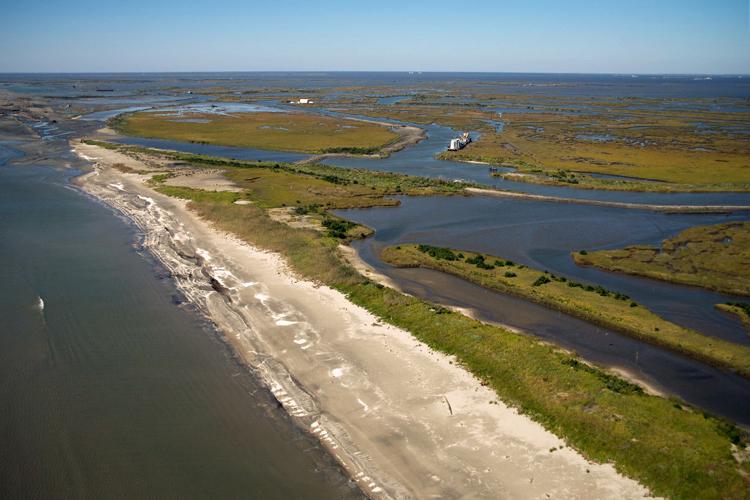
Before the term “climate refugee” became part of the conversation about the future, it was already describing something happening in Louisiana. Isle de Jean Charles is a narrow strip of land in Terrebonne Parish, about two hours southwest of New Orleans. The Biloxi-Chitimacha-Choctaw people have lived there for generations. Since 1955, the island has lost 98 percent of its land mass. What was once a 22,000-acre island is now a strip barely a mile wide, accessible by a single road that floods so regularly residents have learned to read the water before they drive it
What the Island Was
Isle de Jean Charles was settled in the early 19th century by members of the Biloxi, Chitimacha, and Choctaw nations, along with Cajun families, who were pushed onto the island after being excluded from surrounding land. Over generations, they built a community entirely adapted to the water: subsistence fishing, trapping, and farming on land that was productive and lush.
The island had forests. It had farmland. It had a school. It had a community that knew how to read the weather, the tides, and the seasons in ways passed down through generations. The land was not just where they lived. It was the context for everything they knew.
What Happened to It
The same forces destroying the rest of the Louisiana coast hit Isle de Jean Charles harder and faster than almost anywhere else. Canal dredging by the oil and gas industry opened the surrounding wetlands to saltwater. The marshes that once buffered the island from the Gulf began to die. Storm surge from hurricanes had less and less to slow it down before it reached the island.
Betsy in 1965. Carmen in 1974. Andrew in 1992. Lili in 2002. Katrina in 2005. Rita in 2005. Gustav and Ike in 2008. Each storm took more. The road to the island flooded more frequently. The land on either side of it disappeared. Families began leaving, not all at once, but steadily, house by house and generation by generation.
By the time federal attention arrived, the population had fallen from several hundred to a few dozen. The school was gone. The community was fragmenting under the weight of repeated displacement and the slow erosion of everything that had held it together.
The Relocation Grant
In 2016, Isle de Jean Charles received a $48 million federal grant through the Department of Housing and Urban Development to relocate the remaining community to higher ground. It was the first federal grant explicitly designated for climate relocation in the United States, and it drew international attention.
The process has been slow, painful, and contested. Not every community member wants to leave. Relocation is not just a practical act; it involves severing ties to land that holds ancestors, memories, and identity in ways that cannot simply be rebuilt elsewhere. Some residents have moved to the new site in Schriever, Louisiana. Others have stayed on the island, or moved independently. The community as it existed for 200 years is not intact anywhere.
This is the part of the climate story that does not reduce to a clean narrative. There is no ending where everyone is saved and the culture is preserved and the land is restored. There is only the ongoing negotiation between what was and what is, and the question of what can still be carried forward.
What Their Story Means for Everyone Else
Isle de Jean Charles is not an isolated case. It is an early-stage version of a situation that is coming for many other communities on the Louisiana coast, and in other low-lying coastal areas around the world.
The United Houma Nation faces similar pressures across Terrebonne and Lafourche parishes. Vietnamese fishing communities in Plaquemines Parish have watched their fishing grounds shrink. Generations of Cajun families in towns like Dulac, Grand Bois, and Leeville are watching the land recede around them.
When we talk about coastal land loss as an environmental issue, we are really talking about a cultural emergency. The land is not just geography. It is the material basis for ways of life that took centuries to develop and cannot be replaced by moving to a new zip code.
The story of Isle de Jean Charles is a warning. It is also a record of resilience. A community that did not choose to be in the path of these forces, that fought for its right to stay and then fought to relocate on its own terms, that insisted its knowledge and identity were worth preserving even when the land that held them was disappearing. That matters. It will matter more as the coast continues to change.